


Alcohol and Nerve Regeneration: Why Your Evening Drink is Harming Your Extremities
Discover how alcohol and nerve regeneration are blocked by evening drinks. Learn how ethanol depletes B-vitamins and harms your extremities.

Understanding how much natural insulin your body still manufactures is a crucial turning point in clinical endocrinology. Ordering a c peptide test for diabetes insulin production allows physicians and patients to accurately evaluate pancreatic beta-cell secretory capacity without the confounding interference of injected pharmaceutical insulin. Integrating beta-cell diagnostics with our foundational Health Hub Diabetes Management Guide provides a complete framework for metabolic recovery.
While basic blood glucose tests measure circulating sugar levels, running a c peptide test for diabetes insulin production reveals whether your pancreas is suffering from autoimmune beta-cell failure or producing excessive insulin due to underlying peripheral resistance. Evaluating your pancreatic reserve through a c peptide test for diabetes insulin production helps determine whether lifestyle modifications can succeed. Whether you are exploring strategies on how to reverse type 2 diabetes or differentiating between Type 1, Type 2, and LADA, ordering a c peptide test for diabetes insulin production delivers essential diagnostic clarity.
🔍 Clinical Diagnostic Snapshot: Comparing C-peptide output against long-term lab markers helps clarify the fasting blood sugar vs a1c dynamic. Understanding the difference between average blood glucose and fasting blood sugar ensures you interpret pancreatic secretory output in proper physiological context.
Get instant access to your printable weekly meal planning blueprint for supporting pancreatic beta-cell health. Access your structured diabetic food chart today.
Enter your latest lab C-peptide result (in ng/mL) below to evaluate your pancreatic insulin production capacity according to clinical guidelines.
To appreciate why a c peptide test for diabetes insulin production is the gold standard in diagnostic endocrinology, we must look inside pancreatic beta cells. When beta cells synthesize insulin, they first manufacture an inactive precursor protein called proinsulin.
Inside secretor granules, enzymes cleave proinsulin into two equal parts: one molecule of biologically active insulin and one molecule of connecting peptide (C-peptide). Because beta cells secrete insulin and C-peptide in an exact 1:1 equimolar ratio, ordering a c peptide test for diabetes insulin production gives an unvarnished window into endogenous insulin secretion.
Direct insulin blood tests can be inaccurate because pharmaceutical insulin injections register on the assay. Conducting a c peptide test for diabetes insulin production solves this problem, as commercial synthetic insulin contains zero C-peptide.
Furthermore, evaluating whether is fasting insulin the same as A1C reveals that while circulating insulin has a rapid half-life of 3 to 5 minutes, C-peptide circulates with a half-life of 20 to 30 minutes. This extended stability makes a c peptide test for diabetes insulin production a far more dependable marker of 24-hour beta-cell capacity.
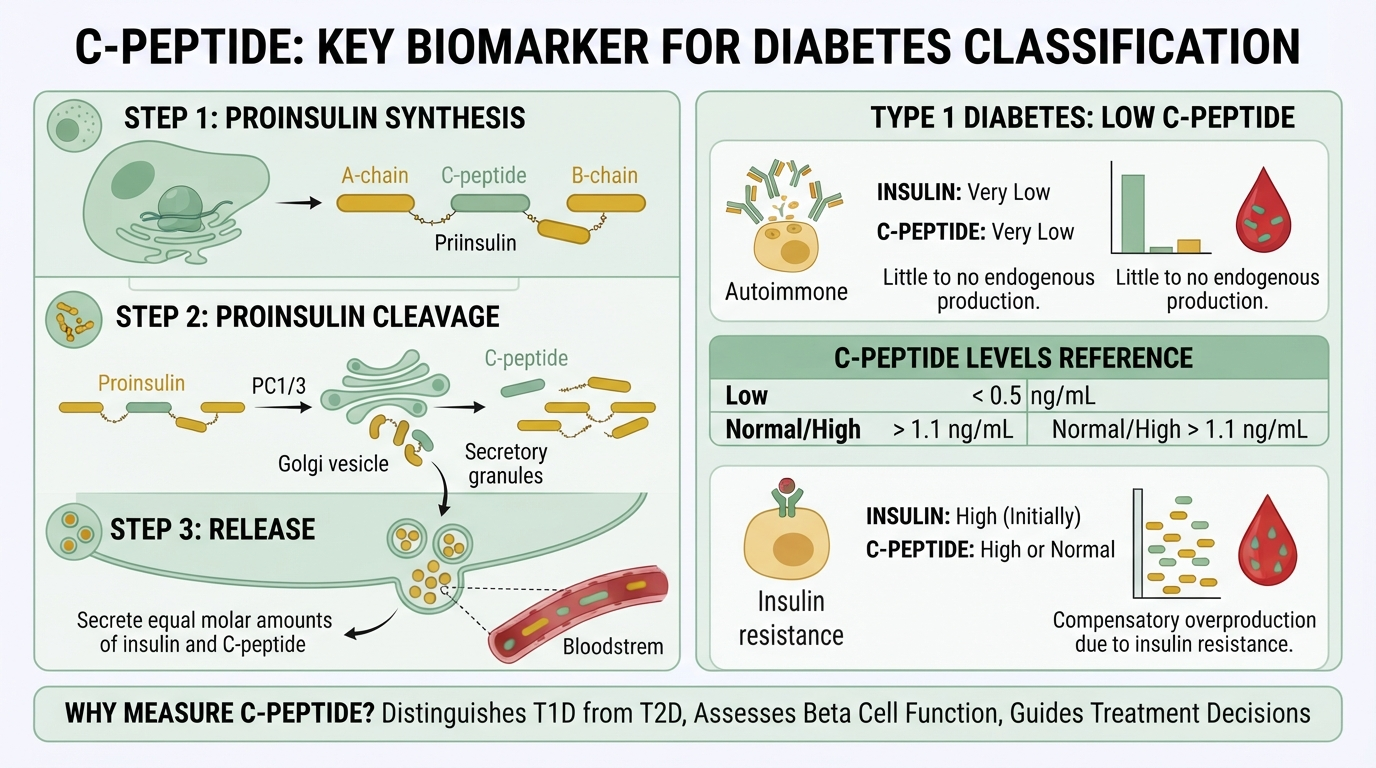
Interpreting a c peptide test for diabetes insulin production requires comparing your lab numbers against established clinical reference ranges. Standard laboratories report C-peptide levels in nanograms per milliliter (ng/mL) or nanomoles per liter (nmol/L):
Correlating your C-peptide results with lab benchmarks like an estimated average glucose eAG vs A1C conversion offers a complete diagnostic picture. Monitoring daily fasting numbers alongside normal fasting blood sugar levels vs A1C guides clinical decisions.
The table below summarizes C-peptide reference values across various clinical classifications when performing a c peptide test for diabetes insulin production:
| Diabetes Classification | C-Peptide Range (ng/mL) | Beta-Cell Secretory Status | Clinical Management Strategy |
|---|---|---|---|
| Type 1 Diabetes Mellitus | < 0.5 ng/mL (Undetectable) | Severe Autoimmune Beta-Cell Failure | Requires Mandatory Lifelong Exogenous Insulin Replacement |
| LADA (Type 1.5 Diabetes) | 0.5 – 1.0 ng/mL (Progressive Drop) | Slow Autoimmune Beta-Cell Destruction | Early Lifestyle Care Transitioning to Basal Insulin Support |
| Healthy Non-Diabetic Adult | 1.1 – 4.4 ng/mL | Normal Physiological Insulin Production | Maintain Balanced Dietary & Exercise Habits |
| Type 2 Diabetes (Early/Moderate) | > 4.5 ng/mL (Elevated) | Hyperinsulinemia & Systemic Insulin Resistance | Target Insulin Sensitivity, Weight Loss & Dietary Restructuring |
| End-Stage Type 2 Diabetes | < 1.0 ng/mL (Secondary Failure) | Beta-Cell Exhaustion / Glucotoxicity Burnout | Requires Exogenous Insulin Alongside Sensitizing Agents |
Recognizing early warning signs of diabetes early helps prevent long-term beta-cell exhaustion.
To ensure your c peptide test for diabetes insulin production yields accurate results, proper pre-test preparation is essential. Depending on clinical requirements, endocrinologists order either fasting or stimulated C-peptide tests:
Understanding why morning readings fluctuate—detailed in why fasting blood sugar is higher than A1C—helps clarify early morning results.
Explore our essential clinical guides below to better understand your blood test results, baseline metrics, and lab preparation rules:
If your c peptide test for diabetes insulin production shows normal or elevated levels, taking steps to improve systemic insulin sensitivity can protect surviving beta cells from long-term exhaustion. Botanical adaptogens such as Eleuthero for Diabetes Fatigue, Coleus Forskohlii Blood Sugar regulators, and Maca Root Energy Blood Sugar balance support steady metabolic stamina without overstimulating pancreatic tissue.
If post-meal glucose spikes trigger reactive hypoglycemia, read about postprandial reactive hypoglycemia symptoms and causes to manage insulin overshoot. Expecting mothers managing fasting numbers can review a gestational diabetes diet plan for safe nutritional guidelines.

Following a c peptide test for diabetes insulin production, adding science-backed natural formulas like the best supplement for blood sugar (Sugar Defender) or evaluating the best blood sugar support supplement (GlucoTonic) helps relieve metabolic strain on pancreatic beta cells.
*Always backed by a 60-day money-back guarantee directly from the official manufacturer.
Answers to common questions regarding a c peptide test for diabetes insulin production, lab prep rules, and pancreatic reserve testing.
A high C-peptide test result indicates hyperinsulinemia, where the pancreatic beta-cells produce excessive endogenous insulin to overcome systemic insulin resistance. Ordering a c peptide test for diabetes insulin production confirms intact pancreatic reserve requiring insulin-sensitizing strategies.
Yes. Low or undetectable C-peptide levels (<0.5 ng/mL) confirm autoimmune destruction of beta-cells in Type 1 diabetes, whereas normal or elevated C-peptide levels (>1.1 ng/mL) confirm intact insulin production typical of Type 2 diabetes.
When patients ask should you fast before a hemoglobin a1c test or a C-peptide test, standalone fasting C-peptide evaluations require an 8-to-12-hour fast. Reviewing standard a1c test preparation rules ensures clean blood sampling.
When evaluating do you need to fast for an a1c test, A1C alone does not require fasting. However, when combined with a fasting c peptide test for diabetes insulin production, fasting is strictly necessary.
C-peptide has a longer biological half-life (20–30 minutes vs 3–5 minutes for insulin) and is not rapidly cleared by the liver. Furthermore, laboratory assays can distinguish C-peptide from injected synthetic pharmaceutical insulin.
Evaluating whether is fasting insulin the same as a1c shows that fasting insulin and C-peptide measure real-time hormone secretion and pancreatic reserve, whereas A1C measures 90-day average blood glucose concentration.
Ordering a c peptide test for diabetes insulin production provides essential clinical insights into your pancreatic beta-cell reserve. Differentiating true insulin deficiency from peripheral insulin resistance ensures that your diabetes management plan targets the exact biological root of your condition.
Get instant access to your printable meal planning blueprint designed to relieve pancreatic stress following a c peptide test for diabetes insulin production. Access your structured diabetic food chart today.
To explore our complete library of diagnostic guides, tracking tools, and blood sugar support reviews, visit our primary Health Hub Diabetes Management Guide or our master reference in The Ultimate Diabetes Guide 2026.
Discover how alcohol and nerve regeneration are blocked by evening drinks. Learn how ethanol depletes B-vitamins and harms your extremities.

Explore how excessive dietary sodium and processed foods impair vascular microcirculation, increasing nerve pain and extremity numbness.

Discover how artificial sweeteners worsen neuropathy and why energy drinks disrupt nerve signal transmission. Protect your extremity health today.

Explore how artificial trans fats and hydrogenated processed oils degrade structural myelin membranes, starving nerve cells of proper electrical insulation.

Discover how smoking and nicotine constrict nerve blood supply through microvascular damage. Learn how tobacco worsens neuropathy symptoms.

Uncover the common daily foods that silently damage your nervous system, trigger blood sugar spikes, and worsen neuropathy symptoms.